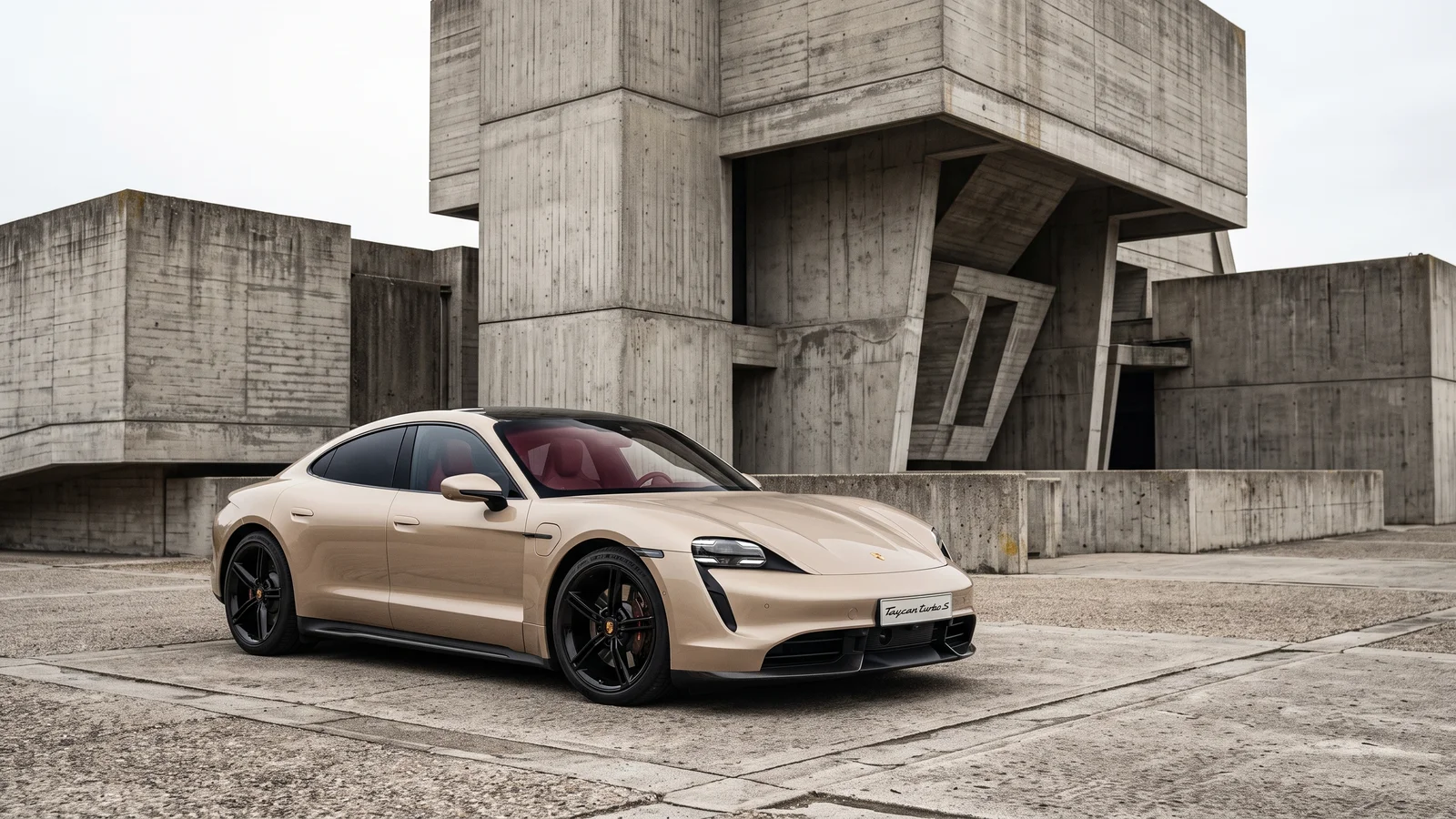
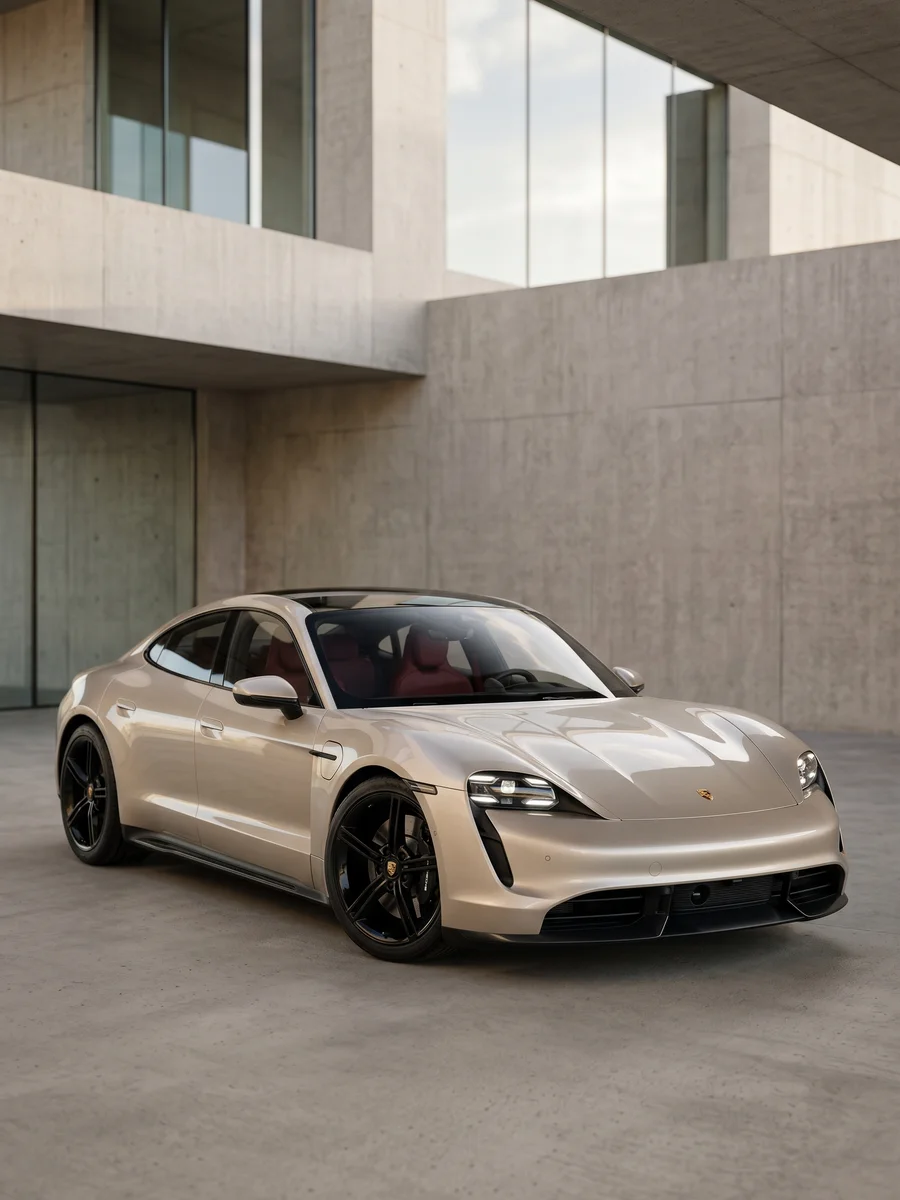
800 volts. Porsche's first series production electric car, presented on 4 September 2019. An 800-volt architecture and a two-speed rear transmission built for repeatable performance, not single-lap numbers.
In production
1,034PS
Turbo GT, overboost
2.2s
0–100 km/h, Weissach
18min
DC 10–80 %
03
Overview
J1, second phase
800 volts.
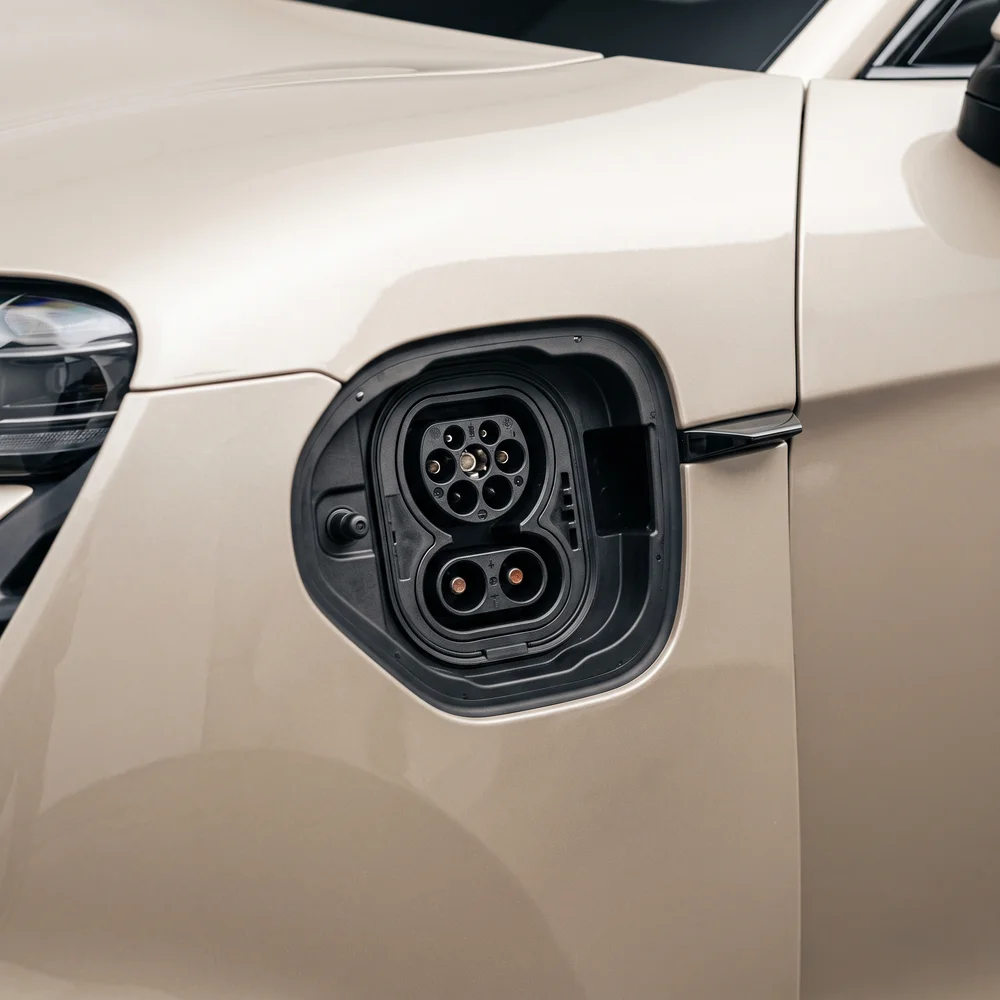
The Taycan was presented on 4 September 2019 at a world premiere staged simultaneously on three continents. Its defining engineering decision was the 800-volt system voltage: thinner cables, lower losses and DC charging up to 320 kW with the Performance Battery Plus. A two-speed transmission on the rear axle pairs a short first gear for acceleration with a long second gear for efficiency at speed.
Each block names one variant, one model year and one market. Figures are not interchangeable between trims — a number quoted for a GTS does not describe a Carrera.
Taycan (rear-wheel drive)
2025 model yearEurope (EU), WLTP
Power
300 kW / 408 PS
0–100 km/h
4.8 swith Launch Control
Top speed
230 km/h
Range (comb.)
520 – 609 km
Consumption (comb.)
19.1 – 16.1 kWh/100 km
CO₂ (comb.)
0 g/km
DC charging 10–80 %
18 minat maximum charging power
Max. DC charging power
up to 320 kWwith Performance Battery Plus
Transmission
Two-speed, rear axle
Source: porsche.com — Taycan model page
Taycan Turbo GT
2025 model yearEurope (EU), WLTP
Overboost power with Launch Control
760 kW / 1,034 PS
0–100 km/h
2.3 s · 2.2 s with Weissach package
Top speed
290 km/h · 305 km/h with Weissach package
Range (comb.)
540 – 559 km · 460 – 555 km with Weissach package
Max. DC charging power
up to 320 kW
System voltage
800 V
Source: porsche.com — Taycan Turbo GT model page
Scope. Values are EU figures
measured to WLTP where applicable and were current when this page was written. Specifications change by
model year, variant and market — always check porsche.com for the current figure in your region.
Interior
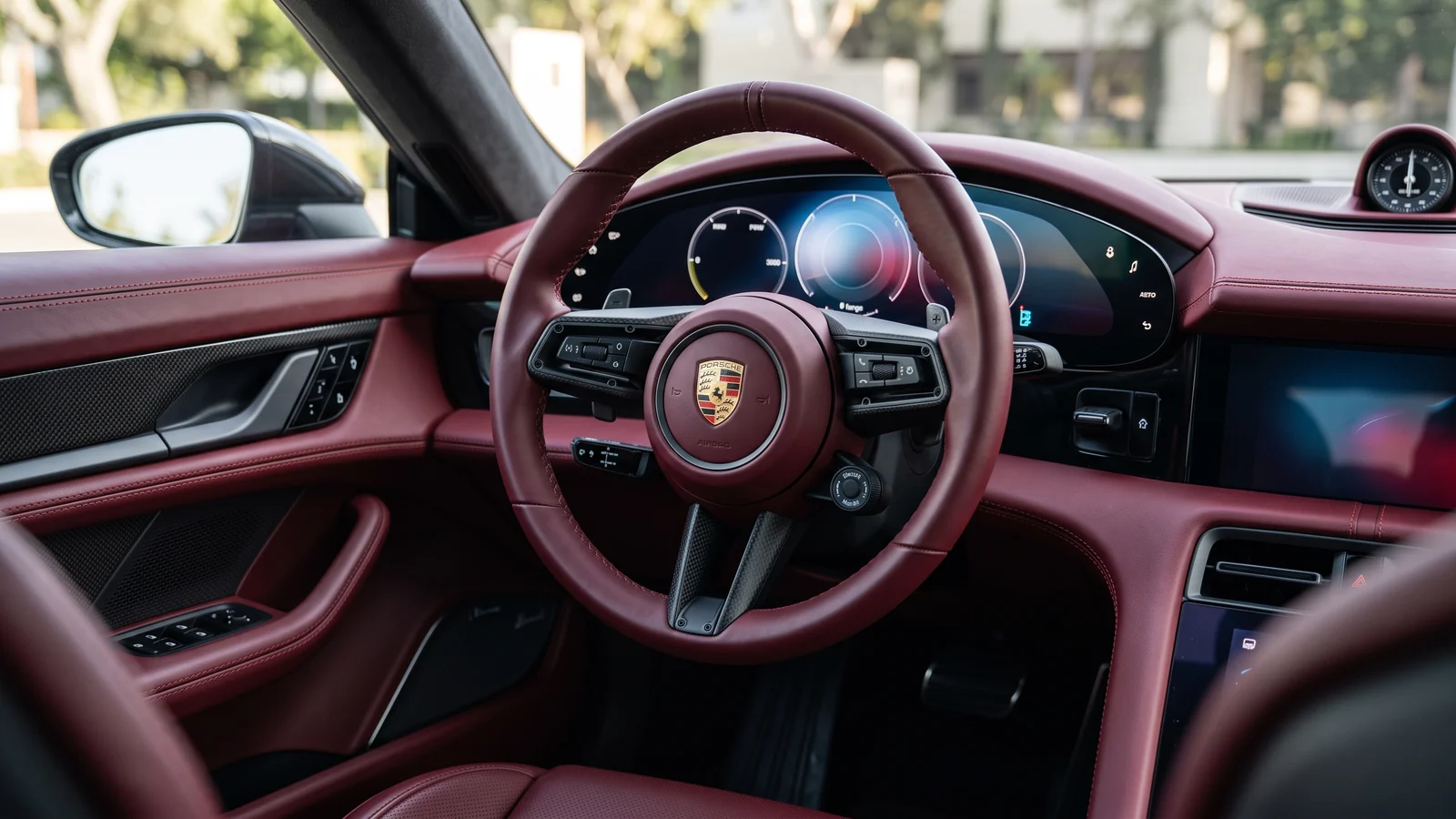
Deep Bordeaux Red
The cabin follows the same rule as the exterior: a small number of materials, used honestly, with the driver as the reference point.
06Lighting Indirect ambient light, no coloured wash
Engineering
How it is built
Four decisions that shape how this car behaves — described in the terms the engineers use, without invented terminology.
800-volt architecture
Doubling system voltage relative to a conventional 400-volt EV halves the current for a given power. That allows smaller cable cross-sections, lower thermal losses and sustained high-power DC charging — the Taycan accepts up to 320 kW with the Performance Battery Plus.
Two-speed rear transmission
A short first gear delivers the torque multiplication needed for launch; a long second gear keeps motor speed and losses low at cruising speed. Most electric cars use a single fixed ratio and compromise between the two.
Repeatable performance
Thermal management is engineered around consecutive full-power launches and sustained circuit use rather than a single headline acceleration run.
Recuperation
The Taycan recovers energy through the electric machines under braking, with the friction brakes blending in only when deceleration demand exceeds what recuperation can supply.